
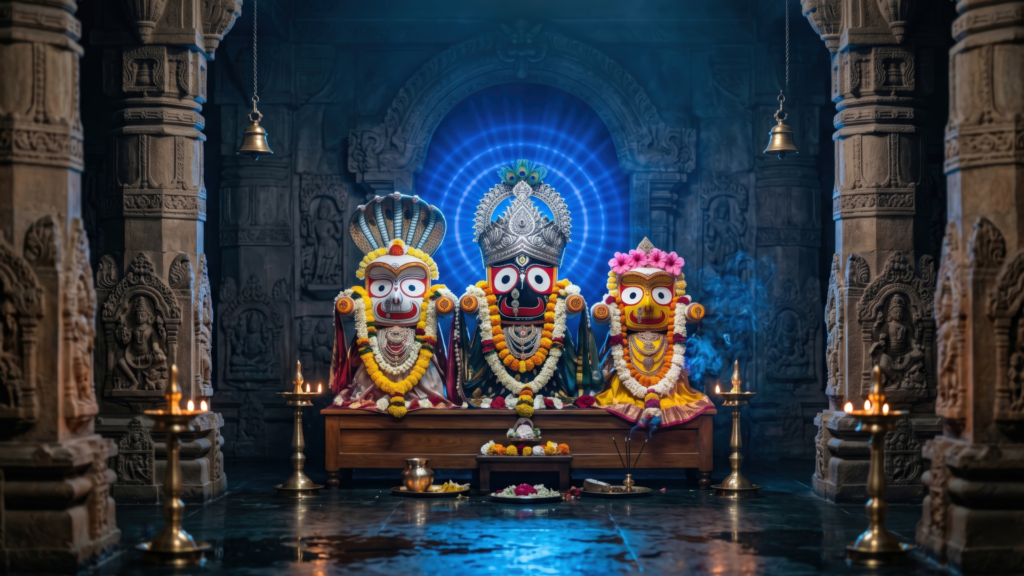
Jagannath Rath Yatra is one of the most powerful, and magnificent celebration of devotion, equality, and cultural heritage. Rath Yatra (रथ यात्रा), meaning “Chariot Festival,” celebrates the annual journey of Lord Jagannath, his elder brother Balabhadra, and sister Subhadra from the Jagannath Temple in Puri to the Gundicha Temple.
जगन्नाथ रथ यात्रा केवल एक धार्मिक उत्सव नहीं, बल्कि समानता और मानवता का संदेश देने वाला पर्व है।
Table of Contents
When is Rath Yatra in 2026?
The rath yatra in 2026 will begin on 16 July 2026 in Puri, Odisha and turn into global cultural tradition. The festival celebrated on the Dwitiya (second day) of Shukla Paksha (bright fortnight) in the month of Ashadha as per the Vikram Samvat calendar.
Top Rituals that are living traditions of the world
The Jagannath Rath Yatra is considered one of the greatest living traditions of the world because its rituals are followed since centuries.
Snan Purnima and Anavasara
Snan Purnima is the ritual where god is made bathe with 108 sacred pots of water. Later on, it is considered and believed that god is ill now and need rest for 15 days, this time is Anavasara, where no one is allowed to visit temple.
इस समय के दौरान भगवान भक्तों को दिखाई नहीं देते। यह समय उनकी उन लीलाओं को दिखाता है, जो इंसानों (मानव) जैसी होती हैं।
Pahandi Bije, Chhera Pahara and Main Rath Yatra Day
After 15 days of rest, god is believed to be recovered from his illness, and ready to visit all his devotees, making an emotional connection between Bhagwan and bhakat.
- Pahandi Bije: The deities are brought out of the temple in a grand ceremonial procession.
- Chhera Pahara: The King of Puri sweeps the chariots with a golden broom, symbolizing humility before God.
- Main Rath Yatra Day: Devotees pull the massive chariots toward Gundicha Temple.
Stay at Gundicha Temple
The god and goddess stay at Gundicha Temple for about seven days. It is believed that they visit their aunt house during this period. Devotees receive a rare opportunity to worship them outside the main temple.
Hera Panchami
On the fifth day, Goddess Lakshmi visits Gundicha Temple looking for Lord Jagannath. This ritual reflects divine love and playful mythology associated with Jagannath culture.
Bahuda Yatra
Bahuda Yatra marks the return journey of the deities from Gundicha Temple back to the Jagannath Temple. This procession is celebrated with equal enthusiasm and devotion.
Suna Beshaa and Niladri Bijaya
Suna Besha is the golden adornment of the deities after their return, when they appear in resplendent ornaments.
After they return, lord Jagannath offer sweets, specially rasagola to Goddess Lakshmi, to re-enter in temple. This sweet ending is one of the most loved part of story. This ritual is called Niladri Bijaya.
After all this Goddess Lakshmi forgave lord Jagnaath, marking the conclusion of this 7 day celebration of festival.
जगन्नाथ रथ यात्रा से जुड़ी जरुरी जानकारी
Jagnath Rath details
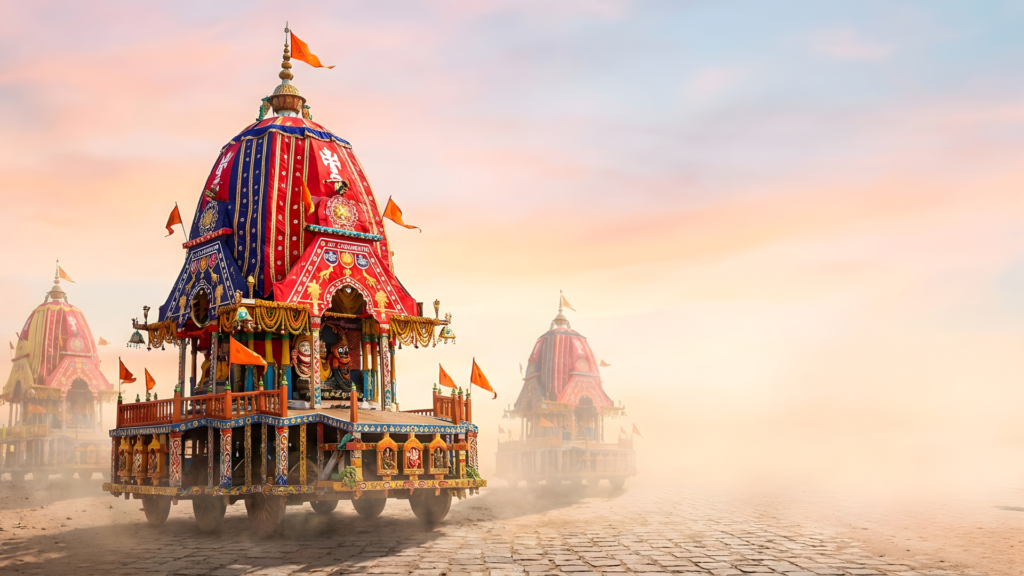
- The grand Chariot of Lord Jagannath is known as Nandighosh, approximately 45 feet tall, made out of complete wood and occupies right side eastern entrance of temple.
- The chariot has 16 wheels, decorated using red and yellow canopy, having 4 white horses and charioteer is called Daruka.
- The chariot is adorned with the sacred flag Trailokyamohini, which represents Lord Jagannath’s power to enchant and protect all three worlds.
Lord Balabhadra Rath details
- The chariot of elder brother Balram is known as Taladhwaja, height of approximately 44 feet, occupies the left side during procession.
- The chariot has 14 wheels, decorated with red and green canopy, having 4 horses, traditionally white and charioteer is called Matali.
- Its emblem is the palm tree, which represents stability, endurance, and the protective nature of Lord Balabhadra, and pulled first.
Devi Subhadra Rath Details
- The devi Subhadra Rath travels in middle of Lord Balabhadra and Bhagwan Jagannath Rath, which is known as Darpadalana, having height of 43 feet.
- The chariot consists of 12 wheels, decorated in red and black canopy, and chariot is believed to be driven by her husband, Arjuna, having 4 red horses.
- The name Darpadalana means “destroyer of pride,” conveying the spiritual message that devotion and humility are essential on the path to divine grace.
A divine Mystery behind the Indian culture religious belief
Jagannath Rath Yatra is not only a grand religious festivals of India, but also a treasure of ancient mysteries. These mysteries are still unsolved, but symbolize faith, devotion, and eternal connection between Bhagwan and Bhakt.
Story behind Divine Heart (the Brahma Padartha)
One of the greatest mysteries of Indian cultural religious belief is the Brahma Padartha, the divine heart of lord Jagannath.
Its exact nature remains unknown. During special rituals, only selected priests can handle it while blindfolded. The secret has been preserved for generations, adding to the spiritual mystique of Jagannath culture.
Nabakalebara ritual after every 12 years
Nabakalebara means a renewal of the divine body. It usually happens after long lunar cycles, often around 12 to 19 years, when an extra Ashadha month appears. The last known Nabakalebara was in 2015, which shows how rare and sacred this renewal is. The next Nabakalebara festival will be held in 2034.
Yeh sirf ritual nahi, rebirth ka symbolic दर्शन hai.
Want to know more 10 amazing mysteries of Jagannath Rath Yatra: Read Here
Mythological legends and mysteries with symbolic meaning
is much more than a festival. It is a celebration of devotion, equality, compassion, and spiritual transformation. From the majestic chariots and sacred rituals to the mysteries of Brahma Padartha and Nabakalebara, every aspect carries profound symbolic meaning.
As one of the most significant religious festivals of India, the Yatra continues to inspire millions and remains a shining example of a global cultural tradition and one of the greatest living traditions of the world. This is exactly why rath yatra matters—it connects people across cultures through faith, humanity, and divine grace.
Frequently Asked Questions About Chariot Festival
When is Jagannath Rath Yatra in 2026?
The Jagannath Rath Yatra will be held on 16 July 2026 in Puri, Odisha. The festival celebrated on the Dwitiya (second day) of Shukla Paksha (bright fortnight) in the month of Ashadha as per the Vikram Samvat calendar.
Why do devotees pull the chariots?
Pulling the chariots is considered as an act of service and blessing, making chariot festival as a living tradition of the world.
What is special about Chhera Pahara?
The Gajapati Maharaja, king of Puri, sweeps the road using golden broom, showing equality before lord.


1 Comment